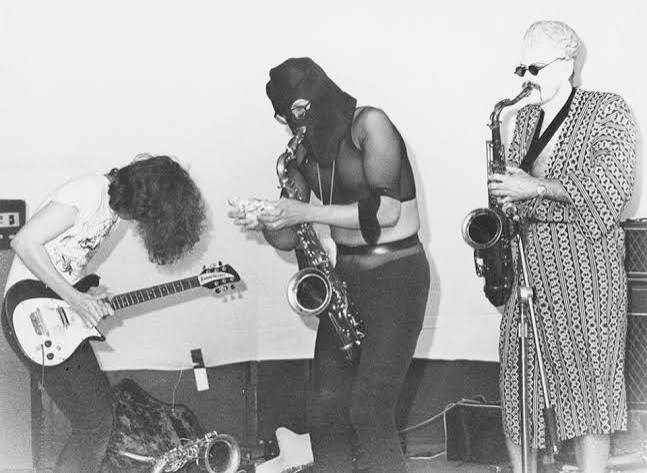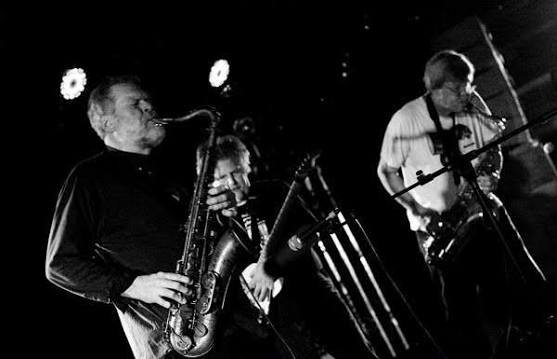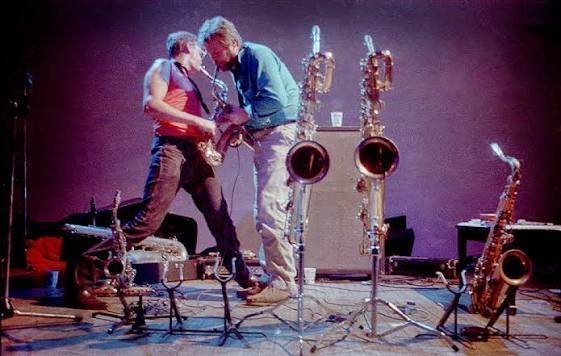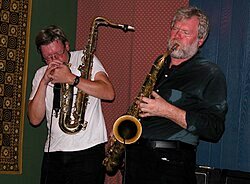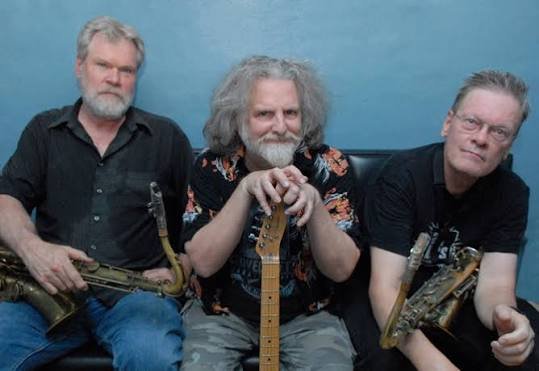
Two tenor saxophones held mouth to mouth, bells pressed against each other, blowing into the same closed chamber. An electric guitar underneath doing nothing that guitars are for. Borbetomagus have been at this since 1979, and the most striking thing about them is not the volume — it is that they arrived at total noise from inside jazz, years before most of the people now credited with inventing it.
A radio show, and three people who would not leave it alone
Donald Miller had a programme on WKCR, Columbia University's station. Jim Sauter and Don Dietrich were listeners who kept ringing in. That is the whole origin story: two saxophonists who would not stop calling a radio host, until the three of them started playing together in 1979.
Adam Nodelman played bass with them briefly. Otherwise the trio has held for over four decades, which for a group this uncompromising is the more surprising fact.
Bells together
The technique that defines them has a plain name. Sauter and Dietrich put the bells of their saxophones flat against one another and play into the join. Neither horn can speak normally: each one is blowing into a sealed volume that the other is also driving, and what comes out is not two saxophones but one instrument neither of them owns.
Sauter has described going further and dropping a microphone down inside the bell while doing it, to wreck the resonant chamber further still. That is a small detail and it explains a great deal — the sound is not distortion applied to a saxophone, it is a saxophone that has been physically prevented from working.
This is why they belong in a harsh noise archive rather than only a jazz one. The method is not electronic and there is no pedalboard in it. It is acoustic sabotage — the same instinct as a contact mic on a sheet of metal, arrived at from the opposite direction.
Who they played with
The collaboration list reads like a map of where improvised music and noise overlap: Swiss circuit-benders Voice Crack, cellist Tristan Honsinger, double bassist Peter Kowald, and Thurston Moore of Sonic Youth. In 2006 they recorded live with Hijokaidan at Victoriaville in Canada — two groups who reached the same wall from opposite continents.
Their records came out mostly on Agaric, their own label, which is the usual answer to the question of who else would have released them.
Japan noticed
They are often described as having influenced Japanese noise. What is actually documented is narrower and still worth saying: their limited At In Roads cassette was reissued on CD by P.S.F. Records, and Osaka's Alchemy Records put out a record of theirs. Two of the most consequential labels in Japanese underground music thought a New York saxophone trio was worth putting into their catalogues.
Whether that is influence or recognition, nobody has demonstrated. It is a real connection either way, and it puts them in the same conversation as the artists in our field guide to the branches and the scene described in harsh noise in the 1990s.
The name
Borbetomagus is the Celtic name for the settlement that became the German city of Worms. No explanation has ever been offered for the choice, and asking for one rather misses the register.
Miller now lives in New Orleans and plays there regularly, often on E-bowed guitars with Rob Cambre and others. The group remains a New York group.
Sources
Formation, personnel, collaborators and discography from Wikipedia. The bells-together method and the microphone detail come from Jim Sauter's own interviews, including Perfect Sound Forever. Written from those facts rather than adapted from their wording.