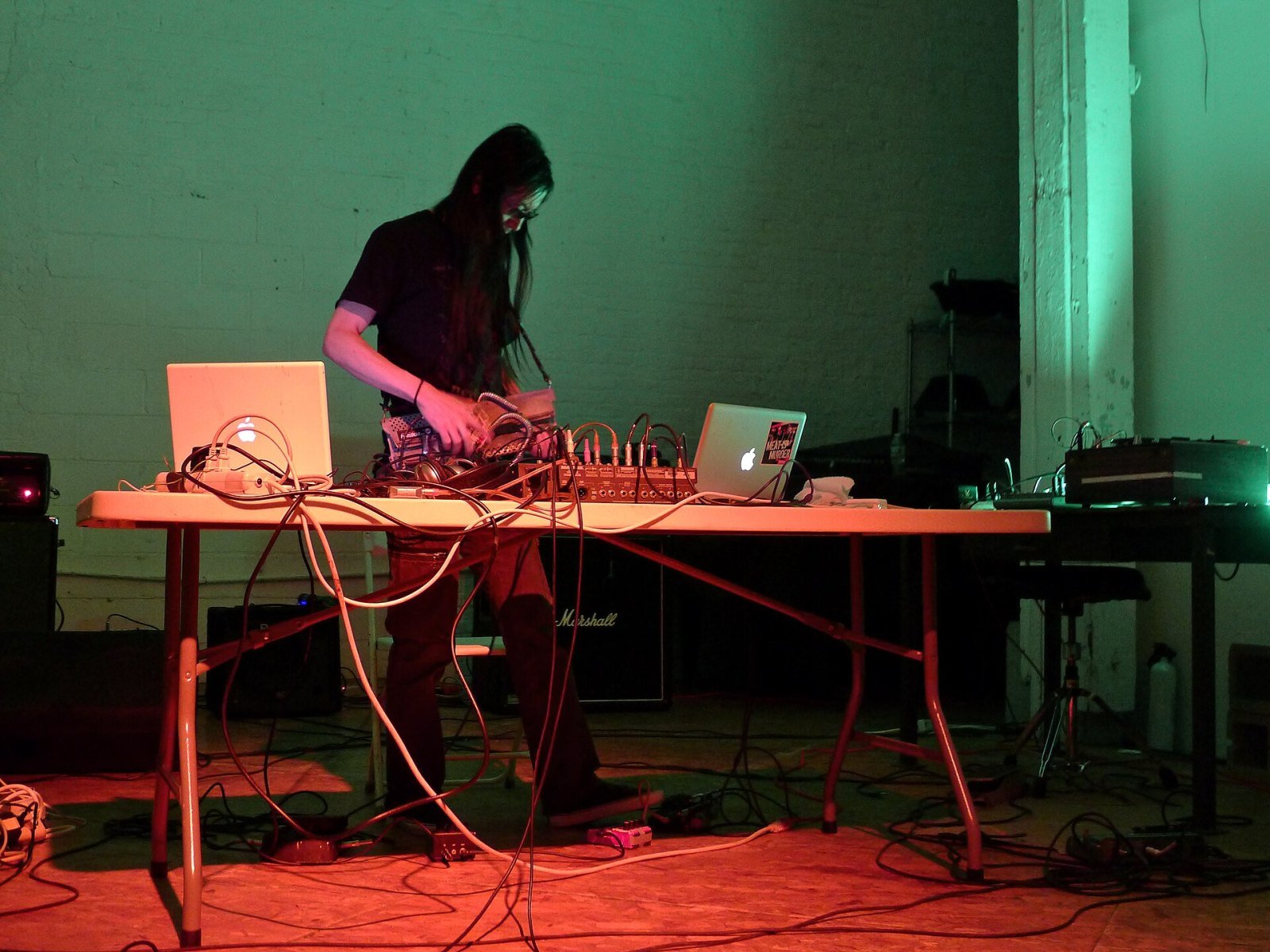
Hijokaidan began in the late 1970s as an improvising project around Jojo Hiroshige, but its most useful definition is not a tidy genre label or a fixed lineup. It is a group that treats noise as an open territory: sound without the familiar obligations of melody, harmony, or rhythm, and performance without a clear boundary between music and disruption. The group’s beginnings in Japan’s Kansai scene, its changing personnel, and Junko’s voice all point toward that same principle: noise is something to inhabit, not something to decorate. Red Bull Music Academy Daily and 4:3 trace different parts of that history.
An emergency staircase
Red Bull Music Academy Daily places Hijokaidan’s emergence in the Kansai No Wave milieu, alongside a broader Japanese punk and experimental scene. Hiroshige had played in Ultra Bide and Rasenkaidan. In the account, an improvised session with guitarist Naoki Zushi and drummer Idiot turned into something more abrasive than the name Rasenkaidan—“Spiral Staircase”—suggested. Idiot’s description of it as an “emergency staircase” supplied the name Hijokaidan.
The first configuration was brief. Idiot did not appear after the initial rehearsal, and Hiroshige and Zushi played as a two-guitar improvising unit. At a 1979 Kyoto performance and a subsequent show at Doshisha University, the sound was described as lacking melody, harmony, and rhythm. Zushi left after the second performance. His departure matters less as a lineup footnote than as an early sign of the project’s central demand: the music asked its players to accept sounds outside conventional instrumental roles.
That history does not resolve into a simple story of one stable band forming once and proceeding unchanged. Red Bull Music Academy Daily describes a later turn in which Hiroshige’s Corroded Mary was billed as Hijokaidan at a 1980 event, and the group took up the name. The Wire’s shorter description likewise identifies Hijokaidan as a noise improvisation unit begun in 1979 around Hiroshige. Taken together, these accounts present the name as attached to a developing practice as much as to a single fixed ensemble.
Noise as a way of listening
The early two-guitar performances described by Red Bull Music Academy Daily were not simply punk played louder. The article distinguishes their ferocity from hard rock and punk, and their chaos from free jazz. The crucial feature was the rejection of the musical signposts listeners normally use to organize sound. Without an evident melody, harmony, or beat, attention shifts to the sound itself and to the listener’s capacity to stay with it.
That emphasis gives Hijokaidan’s noise a point of view. It does not ask the listener to find a hidden tune or to treat abrasion as a route toward conventional resolution. The music’s refusal of those expectations is the substance of the encounter. Red Bull Music Academy Daily connects this openness to Hiroshige’s later idea of “human power”: an ability to take on sounds outside music while remaining within the audible world. The account presents this as a demanding relationship with sound, not as a technical recipe.
The idea also helps explain why changing membership does not cancel the project’s identity. A group built around improvisation and a willingness to leave familiar musical structures behind can persist through changes that might otherwise define a different band. The Wire calls Hiroshige the project’s starting point; 4:3 describes him as its leader. The emphasis is less on a complete personnel chart than on the continuing pull of an approach.
Performance without a safe distance
Hijokaidan’s reputation is tied to live events that could extend beyond what happened through the speakers. Red Bull Music Academy Daily describes smashed venue lights, emptied fire extinguishers, and garbage and raw fish strewn about. 4:3 also characterizes the group’s performances as scandalous, mentioning urination on stage and the destruction of lights and equipment. These reports make the performance history difficult to separate from the group’s musical identity: the audience was not promised a controlled setting in which noise remained safely contained as sound.
That physical extremity is not a substitute for the music. 4:3 describes an “exhilarating tension” in the performances, and connects that tension to the group’s unsettled quality. The point is not simply that a show might become chaotic, but that the sound and the event could resist the usual separation between performers, equipment, venue, and audience. This helps clarify why the group’s early performances have been remembered as more than unusually loud concerts.
There is a risk in letting stories of destruction become the whole account. The available descriptions also emphasize improvisation and the character of the sound itself. The stage incidents are part of Hijokaidan’s history, but they do not explain why the group’s noise holds attention. For that, the more revealing detail is the refusal of musical and theatrical boundaries at once.
Junko’s voice
Junko’s high, screamed vocals became one of Hijokaidan’s defining elements. 4:3 describes her voice as an especially forceful part of the group’s sound. In an interview with ATTN:Magazine, Junko says that her voice in Hijokaidan comes naturally and that she does not train for it. She also describes the group as making her voice this way by nature, and says she can play freely with Hijokaidan.
That account resists the idea that the vocals are a carefully manufactured effect. Junko acknowledges that her voice can make listeners unhappy or uncomfortable, but she does not describe that response as a sound she has set out to imitate. Asked whether she is aiming at particular disturbing noises, she says she plays naturally by herself and associates noise with trouble and irritation. The tension is important: the impact is severe, but her explanation is not a plan to reproduce a specific scream or sound.
Junko’s place in the group also shows how Hijokaidan’s method can make a performer’s physical presence part of the music without reducing it to spectacle. Her voice is described as high-pitched and screamed, but her own account stresses naturalness and freedom rather than a training routine. The result, as presented in these sources, is not an ornament placed over an established noise style. It is one of the means through which that style becomes immediately bodily.
A project, not a closed chapter
The sources suggest a project whose identity has outlasted its first configuration. The Wire describes Hijokaidan as starting in 1979 around Hiroshige, while Red Bull Music Academy Daily recounts the short life of the early guitar pairing and the later use of the name by Corroded Mary. 4:3 links the band’s ongoing force to Hiroshige’s guitar approach and to Junko’s vocals. These are different angles on a group that has never depended on one unchanging lineup to communicate its central idea.
There is not enough in the supplied sources to establish a definitive current lineup or a complete account of every period. What they do establish is a clear through-line: improvisation, resistance to conventional musical structure, and performances whose intensity could spill into the space around them. Hijokaidan’s significance in these accounts lies not in a neat evolution from one style to another, but in keeping that unsettled relationship with sound alive across changing personnel and performance contexts.
For listeners approaching the group through its reputation for extremity, the most useful starting point is not the legend of a particular incident. It is the group’s underlying proposition: noise can be the whole musical event, and the people making it need not soften its effects into familiar forms. Junko’s voice sharpens that proposition, while Hiroshige’s continuing role gives the project an anchor without making it seem fixed. Hijokaidan’s emergency staircase remains an apt image—not because it offers an orderly route out, but because it names a way into a different space.
Watch
Hijokaidan - King of Noise (Full Album) — Harshnoise Channel, via YouTube.
Sources
- ATTN:Magazine, Interview: Junko Hiroshige
- Red Bull Music Academy Daily, The Birth of Noise in Japan
- The Wire, Hijokaidan
- 4:3, Hijokaidan: Music For Psychological Liberation
- NOISEXTRA, Hijokaidan – King of Noise
- Wikipedia, Hijokaidan