The Architecture of Pure Chaos
Across the 1990s, technical failure stopped being a problem and became a method. An account of how equipment breakdown was turned into form, who did the work, and on what gear.
Editor's note. The two rankings in this article are conceptual, not measurements. They illustrate relationships between ideas; they are not research data and should not be cited as statistics.
Harsh noise in the 1990s is the period when sound artists stopped treating distortion, feedback, and signal collapse as interference to be removed and started treating them as the primary material. What changed wasn't the equipment. It was who got to be right when the equipment failed.
In classical Shannon-Weaver communication theory, noise is the enemy of the signal. It degrades meaning. The 90s harsh noise movement inverted that premise in the simplest way available: remove the carrier signal entirely, so that interference is all that remains. That interference became the information source.
The impact carried well beyond the scene itself, and most of the techniques on any noise pedalboard today were worked out during this decade.
Why noise inverts information theory
The classical communication model places noise outside the message. There's a sender, a message, a channel, and interference corrupting that channel. The engineer's job is to push the interference as low as possible.
Harsh noise discards the entire framework. When there is no message to transmit, there is nothing left to corrupt. Signal-to-noise ratio loses its meaning, because the denominator is zero.
Noise is the beginning of the world, or at least the beginning of the signal. In the 90s, it became the end of representation.
This article's working formulation, not a direct quotation
The SIGNAL VS INTENSITY list at the end of this article sets that out as a progression. The less signal there is to read, the more aesthetic weight texture has to carry. At the far end, nothing remains that can be read as a message.
Who built the Japanoise ecosystem
The 1990s are often called the golden era of Japanese harsh noise: a decentralised network that bypassed every industry gatekeeper through international tape trading. Six projects define the shape of it, listed in full under THE NETWORK at the end.
Incapacitants began in Osaka in 1981 as the solo project of Toshiji Mikawa, also a member of Hijokaidan. Mikawa moved to Tokyo in 1986 and met Fumio Kosakai there, forming the duo known throughout the 90s.
How the techniques and gear work
90s harsh noise rests on two things: no-input mixing and cascaded distortion chains.
Technically, systems like these behave as chaotic oscillators. Output is fed back into input, and the result is an unpredictable waveform that routinely exceeds the dynamic range of standard recording equipment. That isn't a tolerated side effect. It's the target.
Five core techniques and the equipment behind each one are set out under TECHNIQUES at the end of this article.
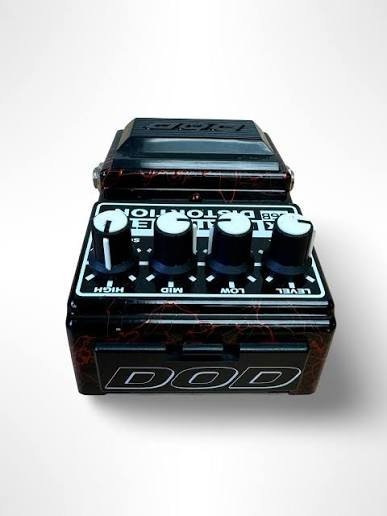
None of these techniques requires expensive equipment. What they require is a used mixer, a few cheap pedals, and a willingness to push all of it past the point the manufacturer recommends.
How far the influence travelled
By the mid-90s the harsh noise aesthetic began permeating adjacent industries, and some of the mainstream. Three routes carried it.
The label route. Merzbow entered the extreme metal market through Relapse in 1994, and that move carried noise to grindcore and sludge listeners.
The digital route. Mille Plateaux and the glitch scene used CD skipping and software errors as compositional tools.
The mainstream route. Bands like Nine Inch Nails and Nirvana used feedback and noise walls as commercial markers of authenticity.
A relative ranking of how deeply the aesthetic was absorbed into each area is under HOW FAR IT SPREAD at the end. Those positions are illustrative and come from no measurement.
Four marker releases
Venereology and Pulse Demon came out on Release Entertainment, Relapse's sublabel. Inner Mind Mystique followed on the same label in 1996. Fabrication was released by Alchemy Records — Discogs and NoiseWiki date it to 1992, while Rate Your Music lists 1991. Full details under MARKER RELEASES at the end.
Sources
Discogs — Masonna, Inner Mind Mystique (1996) · Discogs — Incapacitants, Fabrication · NoiseWiki — Incapacitants discography · Rate Your Music — Incapacitants · MusicBrainz — Release Entertainment issue data · Novak, David. Japanoise: Music at the Edge of Circulation. Duke University Press, 2013.