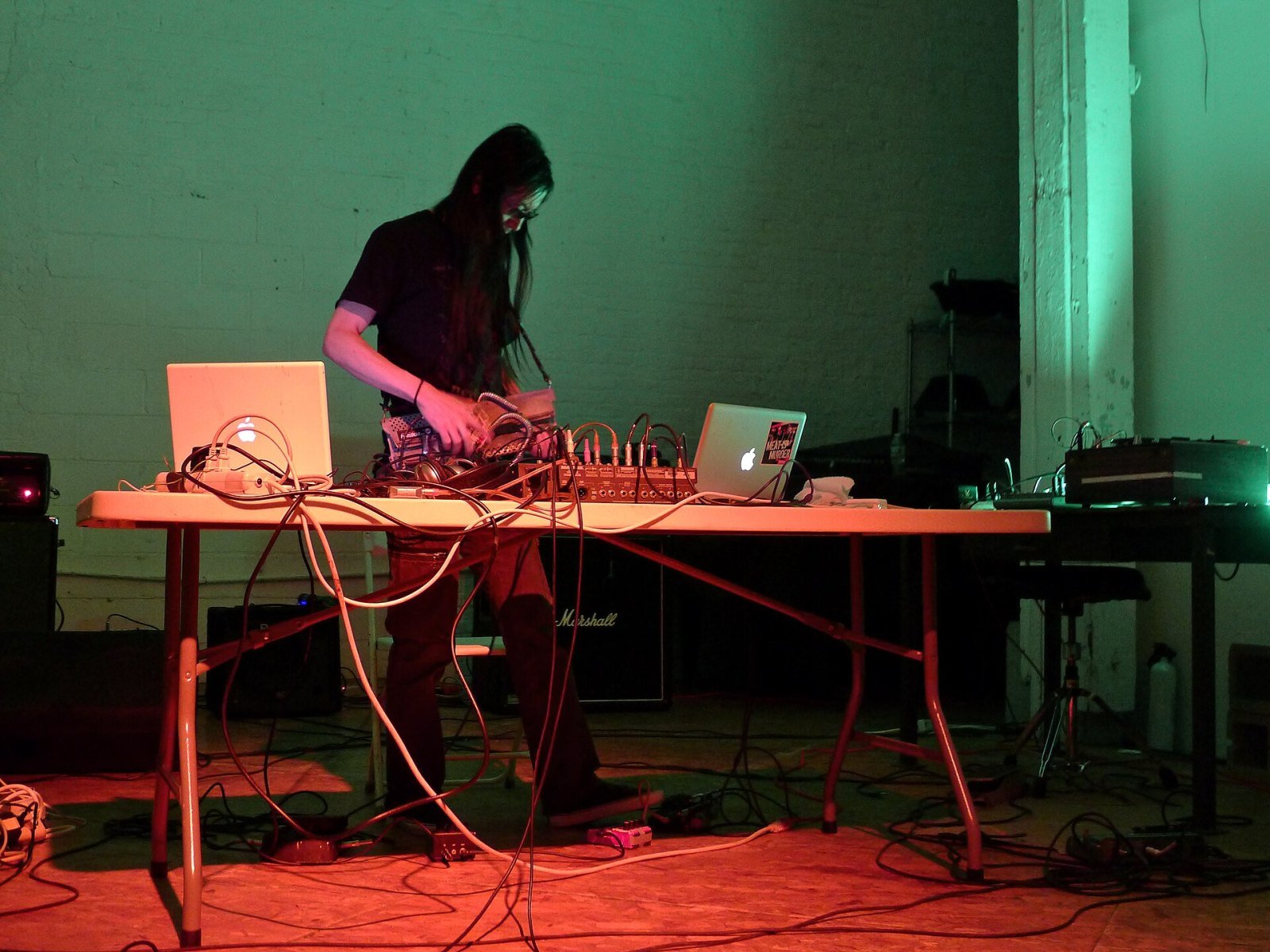
Merzbow is the project of Tokyo-based artist Masami Akita, begun around 1979. Its reputation can make the music seem like a single proposition: volume, distortion and endurance. But the sources point to something more deliberate. Akita has described sound as material to select and combine; critics have heard careful structure and shifting detail inside the apparent overload. That tension—between noise as force and noise as composition—is a more useful guide to Merzbow than any one album or era.
Noise as material
Akita’s early route to noise crossed rock, improvisation and art. In an interview with Lawrence English, he recalled listening to Japanese garage and psychedelic pop, British and American rock, progressive music, free jazz and improvised music. He played drums with schoolmates from around 1972, then began leaning toward improvisation. Later, the recorded work of Pierre Schaeffer, Lou Reed’s Metal Machine Music, Xenakis and Walter Marchetti helped open another path: making tape music from non-instrumental sound.
Akita distinguished his early practice from the industrial groups he had encountered. Rather than building tapes from instruments alone, he recalled using field recordings of sounds from his surroundings. The cassette was not just a container for the finished work; it was a working medium for assembling and altering sound. In a 1997 interview, he described tapes as raw material and compared noise to “colorful inks of an illustrator.” The image suggests an approach based on choices and relationships, not simply on making the loudest possible sound.
His description of the project also resists turning it into a manifesto. Asked what Merzbow communicates, Akita said he was working from his own sensation and did not control how listeners heard the result. He described making music for pleasure, combining sounds he liked. Noise, in this account, is neither a puzzle with one correct interpretation nor merely a rejection of conventional music. It is a personal method of working with sound.
Beyond the extreme-noise shorthand
Merzbow’s public image is closely bound to harsh noise, but the sources caution against treating that association as the whole catalogue. The Quietus’s 2013 profile points to the project’s shifts from tape-based work to laptop-generated static, while also naming different strands in the recorded output: the harsh noise of Venereology and Pulse Demon, the jazz-inflected Door Open at 8am, and the series 13 Japanese Birds. These examples make range more than a theoretical claim. They show that the project’s identity has persisted across changes in process and sound.
Akita has also rejected the idea that his work is only a reaction against other music. In the Perfect Sound Forever interview, he said that he likes melody and rhythm, even though Merzbow takes a different path. That distinction matters: absence of familiar song structures does not mean an absence of musical decisions. It shifts attention toward timbre, density, duration and the way sounds are mixed.
For a listener approaching the catalogue, this means that the most famous records are not necessarily a complete introduction. Pitchfork’s review of MONOAkuma, a 2012 live recording released by Room40, describes it as an entry point that brings together analog and digital extremes. The review hears a long, forceful performance that gradually yields flickers of rhythm and a beat beneath the noise. It also points to more beat-oriented and softer-focus works elsewhere in the catalogue. Its useful implication is not that one route is correct, but that Merzbow offers several different listening problems.
Structure inside intensity
The difficulty of Merzbow is often framed as a test of endurance. Pitchfork’s account of MONOAkuma offers a more specific description: the single, 50-minute track moves through changing textures, from industrial weight to piercing tones, with filters that can make the ear perceive rhythms and patterns. In that review, moments of rhythm are scarce but consequential because they emerge against such sustained density.
This is one way to understand why sheer duration and loudness do not, by themselves, explain the music. A performance can make time feel unstable, while small changes in tone or pulse give the listener something to follow. Pitchfork describes the live experience as capable of feeling like either an instant or an eternity. That is the critic’s account, not a universal promise; it nonetheless captures a recurring feature of Merzbow’s work as presented in these sources: perception is part of the composition.
The recordings also complicate the assumption that apparent chaos is unedited. Discussing Cuts, his collaboration with drummer Balázs Pándi and saxophonist Mats Gustafsson, Akita said the trio recorded improvised sessions in a studio after a performance in Budapest. He took the recordings back to Tokyo and edited them, making few structural changes; one saxophone part was moved. His version then went back to Budapest for Pándi to edit. Improvisation and post-production were not competing explanations for the album. They were stages in its construction.
Collaboration as a change of method
Collaboration gives Merzbow a way to test how its sound behaves in relation to other musicians. Akita told The Quietus that he and Pándi had started working together around 2009 and that the idea of adding Gustafsson to the trio came from Pándi during a European tour in 2011. Akita already knew Gustafsson from earlier performances. He also explained that he had begun working with drum sounds around late 2008 and played drums on almost every track of 13 Japanese Birds, connecting that series to his own earlier role as a drummer.
These details show collaboration as more than a guest list. A drummer changes the available kinds of pulse and physical attack; a saxophone adds another source to the mix. Akita described Pándi’s playing as connected to metal, grindcore and free jazz, and said it was easy for him to play with the drummer. The point is not that the trio resolves noise into conventional ensemble music. Rather, each musician brings material that can alter the conditions under which Merzbow’s sound is made.
Akita’s work with others has taken many forms. The Quietus mentions collaborations ranging from underground musicians to figures including Genesis P-Orridge, Richard Pinhas and Sonic Youth. The available sources do not establish a complete account of those projects, but their variety reinforces a central point: Merzbow is not defined by isolation. Its method can be solo, edited from improvisation, or shaped through exchange.
A catalogue without a single doorway
Merzbow’s scale can make the discography feel like an obstacle. HHV Mag describes the project as having more than four decades of creative work and notes that listeners commonly associate it with a handful of albums, including Venereology, Pulse Demon, 1930 and Noisembryo. The same article stresses that these familiar reference points represent only a fraction of the work. The catalogue’s size is part of its identity, but it should not be mistaken for a demand that every listener master it.
A practical way in is to choose a question rather than a ranking. What changes when Akita works with tape? How does a live performance make time feel different? What happens when drums enter the arrangement, or when another musician becomes part of the process? The cited records and interviews offer different places to begin, without making any one of them the definitive Merzbow.
That openness is the point. Merzbow can be punishing, but the work described here is not reducible to punishment. Akita’s own account emphasizes selection, mixing and sensation; the reviews emphasize shifts, detail and structure; the collaborative recording process shows editing at work. Listen through those lenses and noise becomes less a fixed wall than a field of decisions—one that can be abrasive, rhythmic, unstable or unexpectedly spacious.
Watch
Merzbow Boiler Room Tokyo Live Set — Boiler Room, via YouTube.
Sources
- The Quietus, “Razor Blades In The Dark: An Interview With Merzbow”
- Pitchfork, “Merzbow: MONOAkuma Album Review”
- self-titled, “Lawrence English Interviews Merzbow For Noise Mass Book”
- Perfect Sound Forever, “Merzbow Interview”
- HHV Mag, “Merzbow and the Value of Noise”
Sources
- thequietus.com
- ra.co
- pitchfork.com
- self-titledmag.com
- furious.com
- hhv-mag.com
- Image: Photo: Seth Tisue / Wikimedia Commons, CC BY-SA 2.0