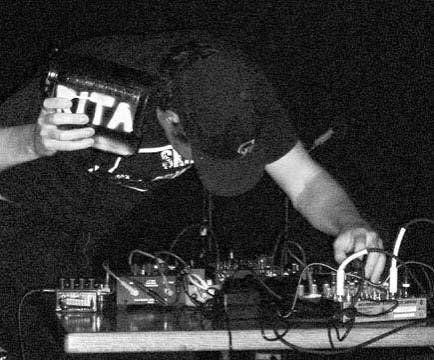
Harsh noise wall has two founders, and they built the genre by disagreeing about what a wall is for. Vomir empties it out. The Rita — the Vancouver project run by Sam McKinlay — fills it back up.
McKinlay describes HNW as a purification of earlier noise traditions — the cascading walls of 1980s Japanese acts like Hijokaidan and Monde Bruits, distilled through the dense crunch of 1990s American projects such as Macronympha, Skin Crime and Richard Ramirez's Black Leather Jesus, down to a single unbroken block of high-gain distortion. Where the genre goes from there splits into two directions, and The Rita and Vomir sit at opposite ends of it.
Name discrepancy — flagged, not resolved. This source gives Vomir's real name as Julien Skrobek. This site's existing Vomir page, sourced from French Wikipedia, gives it as Romain Perrot. Both can't be right. Check a primary source before either page is published, and update whichever is wrong.
The same wall, opposite method
Vomir's method is nihilistic and anti-art, reduced to a personal manifesto: no ideas, no change, no development, no entertainment, no remorse. At shows, plastic bags go out to the audience to wear over their heads, sealing off everything except the PA output. The sound carries no reference to anything outside itself.
McKinlay works the opposite way. For The Rita, the wall isn't a void — it's an ultra-dense container for physical action, lived experience and archival curation. Signal processing, artwork and packaging all get built around a specific theme rather than stripped of one. The full comparison is under THE RITA VS VOMIR at the end of this page.
Sharks, and a contact mic dragged across a reef
McKinlay's longest-running fixation is marine ecology, specifically great white sharks — an interest that started with pulp magazines as a kid and turned into active field recording as an adult. His 2006 album Thousands of Dead Gods is the clearest result of it: field audio from actual cage-diving trips, run through heavy analog distortion.
The source material is direct. Deck audio, the thrashing of the cage floats, water breaking on the surface, other passengers reacting as a shark took the bait. He mixed that with audio pulled from 1960s and '70s shark documentaries on VHS, then ran the composite through high-gain distortion and custom fuzz until it became a wall dense enough to mirror what it feels like staring into open water from inside a cage.
The 2009 follow-up, The Voyage Of The Decima MAS, pairs 1940s naval warfare with the same marine focus. For this one McKinlay went into coastal water himself, wearing an underwater contact mic built into a resin housing by Traumatone, and dragged it against rock faces and submerged reef. On one recording a lingcod struck the lure the mic was attached to — the sound of the fish fighting underwater became part of the wall.
Giallo cinema and archival cover art
Content note. This section covers releases that use archival stills and imagery referencing violence against women, drawn from Italian giallo horror cinema, as cover art. The discussion stays at the level of description and history — no such imagery is reproduced here.
A second thread runs through McKinlay's catalogue: mid-century European exploitation cinema, particularly Italian giallo films built around murder, voyeurism and violence against women. Swingers Get Killed and Possessed Nun Sleaze, both 1998, sit at the start of this thread; Flapper Influence From French Prostitutes continued it in 2005.
The clearest example is Bodies Bear Traces of Carnal Violence (2004), titled after Sergio Martino's 1973 giallo Torso. Rather than staying purely featureless, McKinlay buries recognisable vocal samples from the film inside the mix, surfacing intermittently under the distortion. The cover art pulls from film stills and period press clippings, confronting the listener before the record even starts playing.
Ballet, nylon, and later releases
Later work shifted toward classical ballet and tactile fetish material. Ballet Feet Positions and Gamzatti, both 2014, take their subject from the discipline and physical tension of professional dance.
The 2016 cassette Roman Facesitting, a split with the Italian power electronics project Suction Melena, extended that physical focus into the packaging itself: each tape came individually wrapped in nylon stockings. Not decoration — McKinlay has said the acoustic friction of nylon against skin or a contact mic has served as an actual low-level input signal on some recordings, amplified up into the finished wall.
How the sound is actually built
McKinlay avoids the high-pitched squall and screamed vocals typical of power electronics. The Rita's sound sits in the low end — what gets described as crunch and rumble rather than shriek.
The core instrument is usually a bass guitar run through chained pedals, alongside contact mics. He isn't playing scales; he's manipulating string resonance, body contact and pickup feedback, then pushing that through high-gain overdrive and fuzz until the dynamics disappear. The four-stage chain is set out under SIGNAL CHAIN at the end of this page.
Because the source is always something physical — a fish fighting a line, a stocking dragged over a contact mic, a scraped bass string — the finished wall keeps small internal shifts that a purely synthetic static generator doesn't produce.
Lake Shark Harsh Noise, and clipping.
McKinlay runs the label Lake Shark Harsh Noise (LSHN), which has released work by Caligula031, OVMN and Vast Glory, plus splits pairing McKinlay with other noise artists internationally.
His work has also crossed into hip-hop. The experimental rap trio clipping. — Daveed Diggs with producers William Hutson and Jonathan Snipes — brought McKinlay in to process Diggs' vocals on La Mala Ordina, named after Fernando Di Leo's 1972 crime film. McKinlay ran the recorded verse through his rig until it came out the other side as an unreadable wall of static — the technique applied to someone else's voice instead of his own source material.
A noise wall can be a deeply detailed archive rather than a featureless block of static.
Source
Adapted from a submitted profile of Sam McKinlay / The Rita. Facts as supplied; the real-name discrepancy noted above should be checked against a primary source before publishing.