The Haters have been going since 1979, which makes them one of the oldest continuously operating projects in noise. For roughly the first decade, they made almost no sound at all — and understanding why is more useful than any description of what they sound like now.
Almost everything below is the group's own account of itself. The sources are print zines from the 1980s and 90s, most of them long out of circulation, and the fullest version of this history is one the participants wrote. For an artist whose practice is built on invented vocabulary and self-mythology, that is worth stating plainly rather than smoothing over.
A noise you could not hear
GX Jupitter-Larsen came out of punk and wanted something else. By his account the noise he was after in 1979 was not audible at all — it was sociological. Social distortion instead of sonic feedback. Whatever one makes of that as a theory, it produced a decade of work that is genuinely unlike anything else filed under this genre.
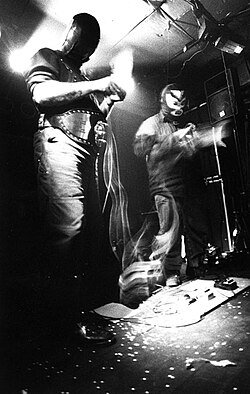
Early Haters performances were actions. Striking video cassettes with a video camera. Watching dust settle on a floor. Counting the bins along a street. If sound occurred it was a by-product, and nobody was listening for it.
Sound arrived as furniture
This is the part worth sitting with. According to the group, audio entered their work for two entirely practical reasons, neither of them musical: they needed a stage curtain, and they needed a clock.
Conventionally a curtain opening tells an audience the piece has begun and its closing tells them it is over. The rooms they played had no curtains. So they started a tape: the sudden arrival of noise marked the start, its abrupt stop marked the end. And because a tape has a length, choosing the tape chose the duration of the performance.
For years they did not care what was on it, only that it was constant. In the studio they were meticulous about sound — but they saw no reason a record and a performance should resemble each other, and did not try to make them.
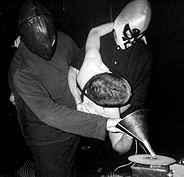
The consequence they describe is the strangest detail in the whole history. Audiences were led — sometimes by people planted among them — into wrecking the venue. Proprietors were not always warned. And when the tape stopped, so did everyone, instantly, with no prior instruction. Twenty people or two hundred, it made no difference. They called these celebrations of entropy.
Then sound became the point
The turn came at their 101st performance, San Francisco, June 1990: performers rubbing calculators against coarse sandpaper, with a contact mic on the props. Still a simple action — but now amplified, and now the sound carried a story. The story was about Ross Rhesymolwaith, a mathematician whose peace of mind was said to sound like exactly that. Calculation by disintegration.
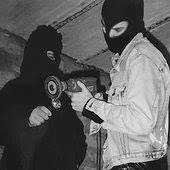
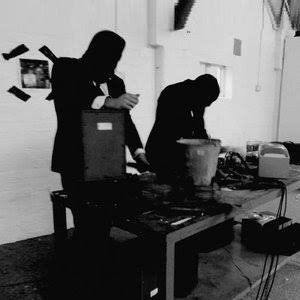
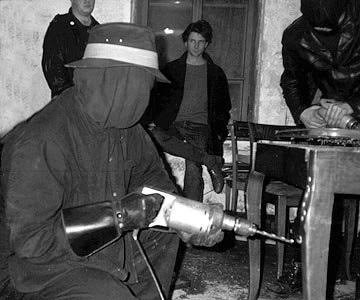
What follows is a catalogue of tools turned into instruments: a hole punch with a contact mic, a live microphone fed slowly into a power grinder, drills reducing wood to sawdust. Larsen's line about the grinder has been repeated in interviews for thirty years — erosion as penetration of the void, on the grounds that erosion is the only way a solid thing can truly enter nothing.
By 1995 the pre-recorded tapes were gone entirely. Later they stopped amplifying found tools and had devices built specifically to make noise, interested by then in the gap between what a sound is and how it was produced.
Records that are not recordings
Around the turn of the 1990s came a run of objects sold as records that contain no recording.
Wind Licked Dirt was an uncut vinyl LP packaged with small pebbles, supplied to play it with. Oxygen is Flammable was a broken shard of plastic in a box, with instructions saying it is a record and is played by pouring water over it — and inviting you to notice how falling water resembles rising fire. Shear was a ball of cotton wool, played by squeezing, its output described as a sharp fluffy slightness. A 1983 single had two blank grooves and told the buyer to complete the record by scratching it.
These are usually filed as jokes. They are better read as the same argument the performances make: the object does not contain the work, the action does.
Wrestling, and a private dictionary
Two obsessions run under everything. The first is entropy and decay, which by now needs no explanation. The second is professional wrestling — described by Larsen as the purest theatre of the absurd, non-confrontational violence with every stereotype pushed past recognition. In 1999 that produced the Untitled Title Belt: a championship belt that is also a microphone, a distortion pedal and a noise generator, and which you would not identify as any of those by looking at it.
He also maintains a private vocabulary of units — the polywave, the totimorphous, the xylowave. They measure things that do not have units. That is the point.
Why they matter here
The Haters made early contact with Merzbow, Maurizio Bianchi and The New Blockaders — which is close to a founding map of the scene — and have since recorded with several of them.
Their real contribution is an argument this archive keeps running into: that harsh noise is not music played badly but a different activity altogether. Plenty of artists say it. The Haters spent a decade proving it by leaving the sound out, and only added it back when they needed something to open the curtain. Read alongside the wall artists in our field guide, they are the other end of the same refusal.
Sources
Built from the Wikipedia entry, whose own citations are largely print zines — Unsound, ND Magazine, The Noiseist, Elekt Noiz, TNT Cosmos — most of them unavailable to check. The one widely accessible source is Nick Richardson's 2010 piece in The Wire. Written from those facts rather than adapted from their wording, and attributed to the group where it is the group speaking.