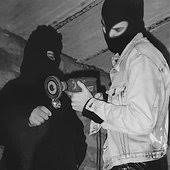
Not the man you found on Google. The Richard Ramirez discussed here is a noise musician from Houston. He has no connection to the serial killer of the same name known as the Night Stalker. The overlap is pure coincidence and has been a burden on the musician for decades.
Content note. This article discusses work built around explicit gay erotica, sadomasochistic imagery, and pornographic cover art. Everything is covered as history and analysis; none of the explicit material is reproduced here.
Richard Ramirez is a harsh noise musician, label owner, and fashion designer from Houston, Texas, active since late 1989 and now based in Pittsburgh, Pennsylvania. He is recognized as one of the earliest American harsh noise artists and one of the most prolific, with a catalog that passes a thousand releases on Bandcamp alone.
The volume isn't why he matters. What matters is what he put on the covers.
Late-twentieth-century power electronics and industrial noise leaned on a visual habit that had already hardened into cliché: war imagery, totalitarianism, state violence, and often enough misogyny. Ramirez broke that pattern by placing gay leather subculture, sadomasochism, and homosexual erotica at the center of his work. As one of very few openly gay artists in the early American noise scene, he received a steady stream of hate mail, and some of that hostility still arrives today.
This wasn't provocation for its own sake. It relocated the male body from perpetrator to exposed and vulnerable, inside a genre that had used violence as its primary language.
Houston, late 1989
His first project was called Flesh Puppets, started in late 1989. Black Leather Jesus followed shortly after, with its first release appearing in 1990.
What pulled him into this territory came from outside America: Nurse With Wound, NON, Merzbow, and The Haters. Soon after he found Emil Beaulieau, Chop Shop, and Hijokaidan. That list of influences matters, because it explains his position. Ramirez wasn't inheriting an existing American tradition. That tradition didn't exist yet. He was one of the people building it.
In 1992 he founded Deadline Recordings, initially alongside Scott Houston and Dwayne Cathey. Both later left to run their own ventures and the label passed entirely to Ramirez. Sterile Technique, the first release under his own name, came out through it.
Old radios, scrap metal, and a wall
Ramirez describes his output as sound art rather than music. Pitch, melody, meter, and harmonic resolution are all discarded. What's left is texture, volume, and timbral density.
The raw material starts with analog radios from the 1970s and 80s, tuned to the gaps between stations where nothing broadcasts except raw electromagnetic interference. That signal is then routed through chains of overdrive, delay, reverb, and pitch-shifting until the feedback begins sustaining itself. To add physical friction to an electronic signal, he brings in junk metal, iron chains, broken audio gear, contact microphones, film samples, and field recordings.
The result saturates the low and mid range: thick distortion over a monolithic low-end drone, with high-frequency static as the outermost layer. This structure places Ramirez among the early architects of Harsh Noise Wall, a subgenre that deliberately discards linear development and leaves only an unchanging block of sound.
HNW works by refusing narrative. There is no beginning, middle, or end. There is one block of sound that holds until it stops.
Black Leather Jesus as ritual
Black Leather Jesus, formed in Houston in 1989, is his main collaborative vehicle and one of the longest-running harsh noise groups in North America.
BLJ doesn't operate like a band. It's a fluid collective that more than thirty people have passed through, and at its peak it put as many as fourteen performers on stage at once. No conventional instruments, no song structures, no vocals. What there is instead: contact-miked scrap metal, industrial equipment, feedback, and the physical manipulation of objects.
The current core is Ramirez alongside his husband, Sean E. Ramirez-Matzus.
An anti-music ritual of entropy and sonic decay, as deeply vulnerable as sadomasochism itself.
ISSUE Project Room curators, on Black Leather Jesus
Collaborations and splits stretch across continents: Merzbow, Incapacitants, The Haters, M.S.B.R., Smegma, Vomir, The Rita, Prurient, CON-DOM, Skullflower, G.X. Jupitter-Larsen, and Thurston Moore, among many others. They have performed in the United States, Canada, Japan, the UK, France, Spain, the Netherlands, Belgium, and Germany.
Deadline Recordings and its sub-labels
Deadline Recordings, founded in 1992 and still running, is the backbone of his distribution and a home for international noise artists the market ignored. The catalog includes names like Merzbow, Atrax Morgue, and The Rita.
He maintains one deliberate distinction: between professionally pressed CDs and LPs, and limited-edition cassettes and CD-Rs. The first group anchors his discography. The second, numbering in the hundreds, is where DIY ethics and tape-trading culture actually live.
Why the imagery matters
First, it dismantles machismo. Early power electronics stood on a hard, heteronormative masculine posture. By placing the male body in positions of exposure, submission, and eroticized vulnerability, Ramirez attacked that posture from inside, using the genre's own visual language.
Second, the queer representation isn't decoration. He didn't borrow gay imagery for shock value and move on. It's his own identity, carried into the work from the beginning, and he absorbed real hostility for it.
Recognition came later. In June 2018, Black Leather Jesus performed in the Queer Trash series at ISSUE Project Room in New York, sharing a bill with (A)sex, Mad Recital, and Rachika S. The curators — Michael Foster, Richard Kamerman, and Eames Armstrong — framed the evening as a rare convergence of the same artists' sound work and textile work.
The second canvas: cloth
Since 1997, Ramirez has run a clothing line under the name Richard Saenz. He later added a line called Automatism, and in 2010, with Sean E. Ramirez-Matzus, launched the label Mad Recital.
The philosophy is identical to the one he applies to sound. Rather than sewing from new fabric, he takes discarded clothing and damages it in controlled ways: burned, frayed, hand-stitched with irregular seams, shaped into silhouettes that refuse symmetry. The stated influences are Martin Margiela, Rei Kawakubo, Ann Demeulemeester, Susan Cianciolo, Junya Watanabe, and Yohji Yamamoto.
The work sells in Osaka, Tokyo, and Paris, including through Trading Museum Comme des Garçons, and has been worn by Kim Gordon, Shirley Manson, Zola Jesus, and Rossy de Palma among others.
Where to start listening
Werewolf Jerusalem — the gentlest entry point. Slow-moving radio static with no sudden attacks. If you've never sat through forty minutes of wall noise, start here.
Black Leather Jesus — the collective, physical side. Metal, chains, and feedback from several people at once. Far denser and far harder going than the solo material.
Splits and collaborations with Merzbow, Incapacitants, and Vomir are the fastest way to place him on a map. Hearing Ramirez next to Merzbow or Vomir clarifies what's specific to him and what belongs to the genre.
richardramirez.bandcamp.com — over 1,000 releases.