Gear Review Joyo Uzi
A cheap high-gain distortion with full EQ and a bias control, tested on contact mics, synths and no-input loops rather than a guitar.
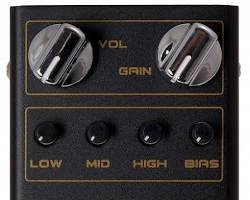
Most cheap distortion pedals give you three knobs and a fixed voice. The Joyo Uzi gives you six, one of which changes what kind of pedal it is.
Source note. The findings below come from a video review by Yotzeret Sheydim, who tested the pedal without a guitar — contact mics, synths and feedback loops instead. This article summarises that work and credits it; the testing is theirs, not ours.
What you get for $30
The Uzi sits at roughly $30 to $35 street, which puts it in the same bracket as the disposable distortion boxes most people buy to abuse. What separates it is the control set: Volume, Gain, Low, Mid, High and Bias.
A full three-band EQ at this price is already unusual. Most budget distortions give you a single tone knob, which means you take the voice you're given. Having low, mid and high separately is what lets you carve a contact mic signal into something that sits where you want it rather than swallowing everything.
There's also a built-in LED with three modes: always on, synced to the footswitch, or off. Cosmetic, but the off setting matters if you play in the dark and don't want a light source on stage.
The bias knob is the reason to care
Bias controls the operating point of the distortion stage. Turn it away from centre and the circuit starts starving — the waveform gates, notes cut off abruptly, and the pedal takes on the character of a broken fuzz rather than a clean high-gain box.
For noise work this does two useful things at once. It adds grit and texture that gain alone won't produce, and it reduces the high-pitched squeal that cheap distortions throw out when you feed them a contact mic. Squeal is usually the thing that makes a budget pedal unusable on non-guitar sources; being able to dial it back without losing the aggression is what earns this pedal its place.
Bias turned out to be the control that shaped harsh texture without letting the feedback run away.
Yotzeret Sheydim, on the contact mic test
How it behaved on non-guitar sources
Six sources were put through it, listed in full under TESTED WITH at the end of this article. Three findings are worth pulling out.
Contact mics. Attached to a computer case, the pedal handled the signal without the usual runaway squeal, provided bias was used to gate it. This is the test that matters most for anyone building a noise rig on a budget.
Synths. On a Cre8audio East Beast, the Uzi added crunch and resonance depth to simple filtered sequences. Paired with power-starved oscillators and CV modulation on an Electro-Lobotomy Hadron Collider, the results turned genuinely unpredictable.
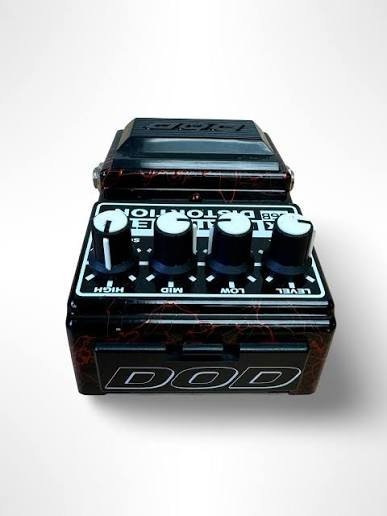
Feedback loops. It held up inside a no-input chain, and stacked reasonably alongside a DOD Carcosa Fuzz, an FX86 Death Metal and an EHX Holy Stain.
Where it sits
This isn't a rare pedal, a boutique build, or something with a story attached. It's a current production box you can order tomorrow, and that's the point — the appeal here is a bias control and a full EQ at a price where you won't hesitate to run something strange into it.
If you already own several distortions, the Uzi probably doesn't open new territory. If you're assembling a first noise rig and want one pedal that handles a contact mic without shrieking, it's an easy recommendation at this price.
Source
Yotzeret Sheydim, Joyo Uzi — Harsh Noise Gear Review [NO GUITARS] — watch on YouTube. All testing described above is theirs.