Gear Analysis DOD Death Metal
Four knobs, no gain control, and thirty years of scene folklore. Separating the DOD Death Metal circuit from the mythology for noise rigs in Noise Scene
Four knobs, no gain control, and about thirty years of scene folklore. Let is open it up.
If you have spent any time in noise circles, you have heard about this pedal. Somebody is zine mentioned it. Somebody is Bandcamp tag list mentioned it. Somebody in a Facebook group told you your wall would not sound right without one, and then quoted a price that made you close the tab.
So here is the thing worth saying up front: the DOD Death Metal is a genuinely interesting pedal with a genuinely strange design. It is also surrounded by more nonsense than almost any other box in the noise world. Most of that nonsense is not malicious — it is just what happens when a cheap pedal becomes scarce and the people who own one need a reason to feel good about it.
This is an attempt to separate the circuit from the mythology.
First, the actual object
The FX86 landed in early 1994. It came out of what JHS Pedals is Josh Scott later nicknamed the "Lamb Series" — a run of DOD pedals designed by Jason Lamb, who took over the analog line and proceeded to make some of the weirdest, most gloriously unmusical distortion boxes of the decade. The Grunge, the Buzz Box, the Gonkulator, the Death Metal. Lamb died in 2016. The pedals outlived him and got strange second lives in scenes he probably never imagined.
The FX86B replaced the original in 1998. First runs were made in the USA; most of the FX86B production moved to China. Around 2009 a DigiTech-branded version appeared with surface-mount guts and, notably, a mixer output the original never had.
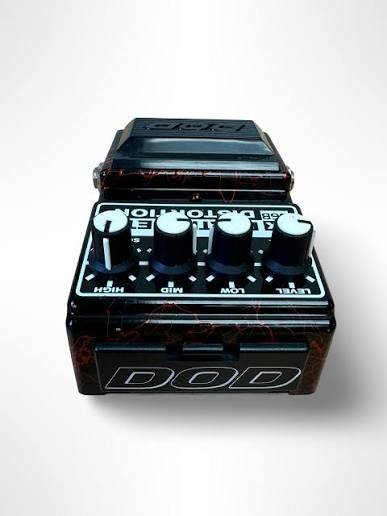
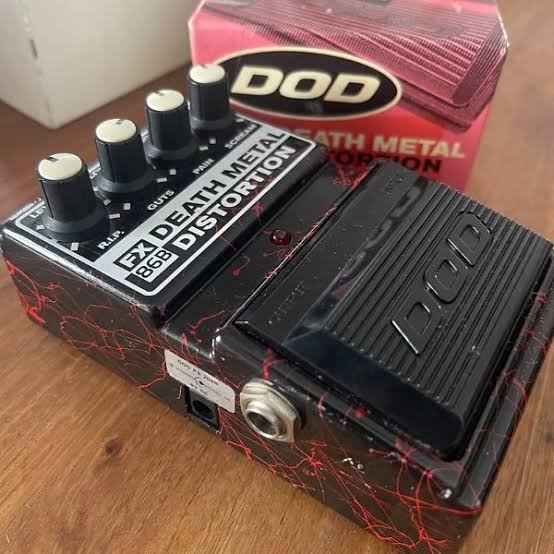
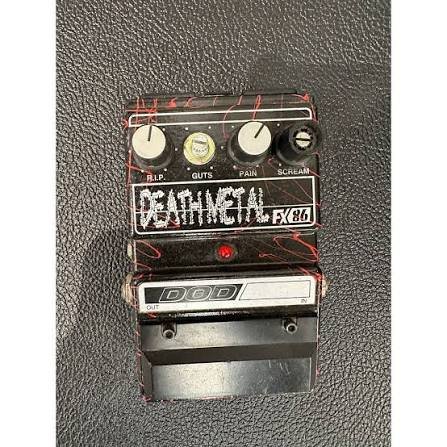
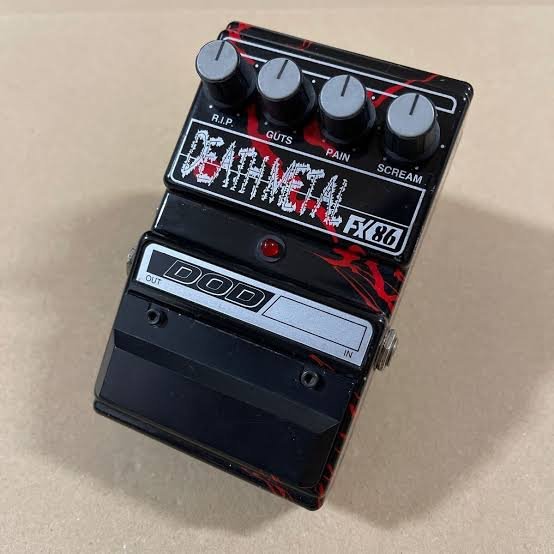
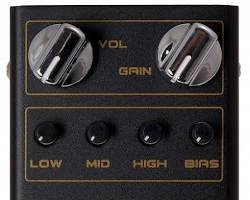
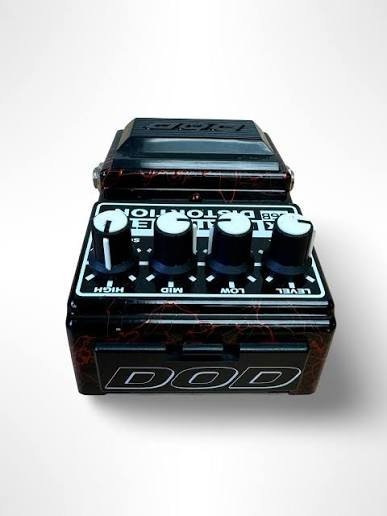
Four controls: R.I.P. (level), Guts (low), Pain (mid), Scream (high). That is it. There is no gain knob. The manual does not apologize for this — it explains, cheerfully, that they "just turned it up and ripped it off!" The gain stage is fixed at maximum by a resistor. You cannot dial it back. This is the single most important fact about the pedal and the source of roughly every myth that follows.
What is actually inside
Four op-amps (4558-type dual chips), several cascaded gain stages, hard diode clipping, a pre-emphasis section that shoves the low-mids up before the signal hits the clipping stage, and an active three-band tone stack. Buffered switching, not true bypass.
No boutique components. No rare germanium. No mystery. The character comes from a very ordinary set of parts arranged to be permanently, unreasonably loud, with nothing anywhere in the chain trying to clean up after it. The high noise floor is not a manufacturing defect. It is what happens when you run that much fixed gain through cheap op-amps with no noise gate. In a metal context that is a problem. In a noise context it is free material.
The myths
"It is the best pedal for harsh noise"
Verdict: myth — a cultural one, not a technical one.
Nothing in the circuit is superior to anything else. What the Death Metal had, for about fifteen years, was availability plus price plus a specific unhinged character. That combination is how gear becomes canonical. Here is the part that gets left out: the pushback came from inside the scene.
"It is just a cheap Metal Zone clone"
Verdict: myth.
The Boss MT-2 has a parametric mid sweep and an "amp in a box" design philosophy. The HM-2 has that famous two-band Swedish chainsaw voicing. The Death Metal has a plain three-band EQ, four op-amps, and no gain control at all.
"The USA originals are way better than the reissues"
Verdict: half true, mostly vibes.
Between the FX86 and the FX86B there is very little circuit difference. Between the DOD through-hole versions and the DigiTech surface-mount one, some players hear the older boards as less compressed and more harmonically open.
"It has infinite gain"
Verdict: half true.
The gain is very high and permanently maxed, which feels like infinity when you are used to pedals with a knob. But it is still bounded by a 9V rail and clipping diodes.
"Your noise is not legit without one"
Verdict: myth, and a slightly insulting one.
Dominick Fernow has described noise as the freedom to chase personal obsession outside of genre and audience. Legitimacy lives in the concept and the execution, not in the enclosure.
"You cannot mod it"
Verdict: myth. People have been modding it for years.
Documented mods floating around DIY forums include swapping the feedback resistor for a resistor-and-pot combination, replacing the 4558s, and adding a buffer in front.
"Cheap pedal, therefore bad" / "the price went up because it is good"
Verdict: half true, and the causality is backwards.
It got expensive because it stopped being made and then got famous on YouTube. Scarcity plus hype, not a sudden improvement in tone.
"It works with any source"
Verdict: half true, and this one matters practically.
It is genuinely great with contact mics and piezos, and it is great as a node in a feedback loop. But the input was designed around guitar-level signals.
"The hiss is a flaw"
Verdict: depends entirely on what you are doing.
For metal guitar, it is a flaw and you need a gate. For harsh noise, it is texture you did not have to generate.
"Battery sounds different from an adapter"
Verdict: not verified.
No credible technical source supports a meaningful tonal difference from clean power. Batteries do drain fast, because of course they do.
So who is actually confirmed using one?
This is where it is worth being careful, because artist attribution is where noise gear writing gets sloppy fast.
Verifiable, with documentation: Government Alpha (Yasutoshi Yoshida), Kazuma Kubota, and Shota Izawa.
Not verified, despite what you will read: Merzbow, Prurient, The Rita, Vomir, Macronympha.
Using it, if you have one
Level is your gain. Since distortion is fixed, intensity gets shaped by the R.I.P. knob and by whatever is feeding it. Put a preamp or buffer in front if your contact mic is too quiet to push it.
Put it in a loop. The classic move is running it as one node in a feedback loop with time-based effects — delay, reverb, flanger — routed back on itself. Turn R.I.P. up and it self-oscillates.
Pain is the wall-shaping knob. Mids build mass. Lows build weight. Highs build grain and screech.
Know the failure points. The footswitch is famously fragile, the battery cover disappears, and at max level it will happily hurt a PA.
The pedal is not the instrument. The loop is.
Harsh Noise Rig Philosophy
The part where we talk about money
Here is the uncomfortable arithmetic for readers in noise scene. Used FX86/FX86B units from the US sit around $75–125. The DigiTech reissue runs roughly $44–70. We could not find a single local IDR listing during research — this is an import-only proposition, and by the time shipping and duties land you are well past $330 for a thirty-year-old pedal with a switch known to fail.
What is actually on the shelf here as alternatives:
- Behringer SF300 Super Fuzz — around Rp550rb. Three modes, plenty of ugliness available.
- Behringer OD300 / HD300 — Rp440rb–570rb.
- Boss MT-2 used — Rp400rb–750rb, and there are a lot of them.
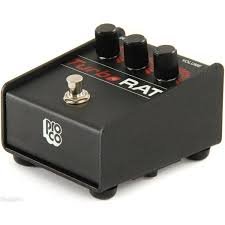
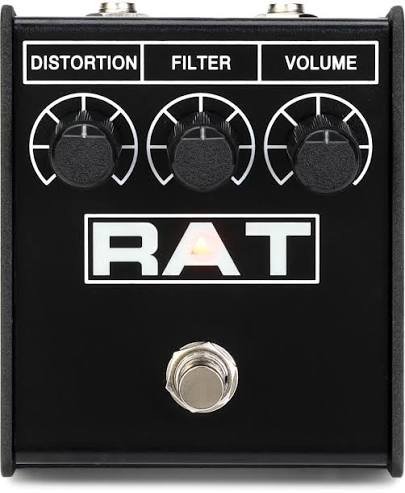
- RAT clones (Mooer Black Secret, Rowin minis) — widely stocked.
- Local builders & DIY — Twinote Metal X, WS SoundFX, IRIN AN-05 around Rp220rb, Joyo JF-35 around Rp450rb–600rb, plus custom handwired builders in Jakarta and Depok, and DIY stripboard clone PCBs around Rp45rb.
The actual point
The Death Metal is a good pedal. It is a funny, ugly, badly-behaved circuit that happened to be perfect for a use case its designers weren not thinking about, and it deserves the affection it gets.
What it does not deserve is gatekeeping duty. Nobody in the audience can hear which distortion pedal is in your loop. They can hear whether you know what you are doing with it.
Build the loop. Learn the gain staging. Buy the pedal later, if at all.
Source
Analysis compiled from community hardware teardowns, historical manufacturer manuals, and scene documentation. Verified artist users include Government Alpha, Kazuma Kubota, and Shota Izawa.