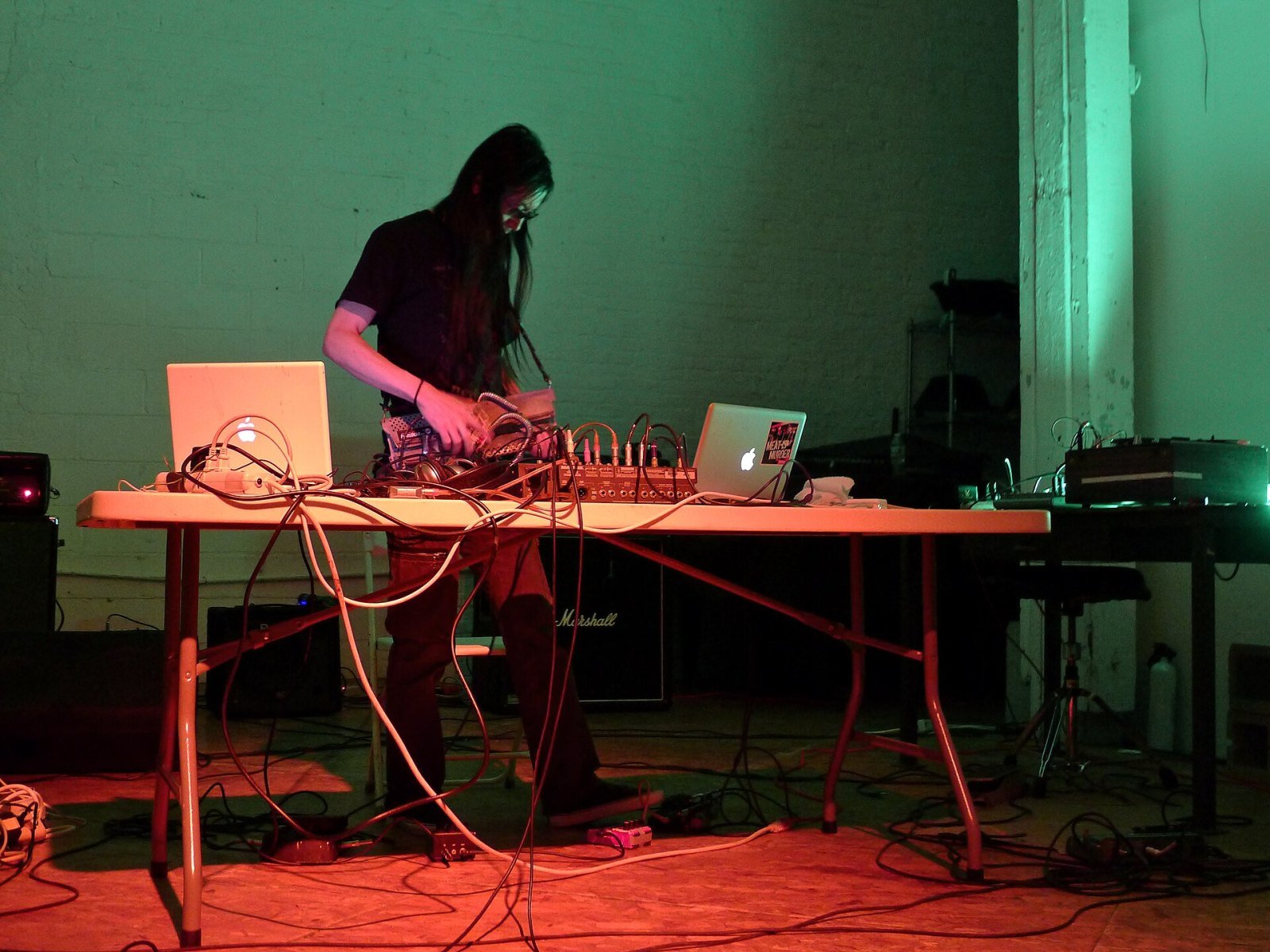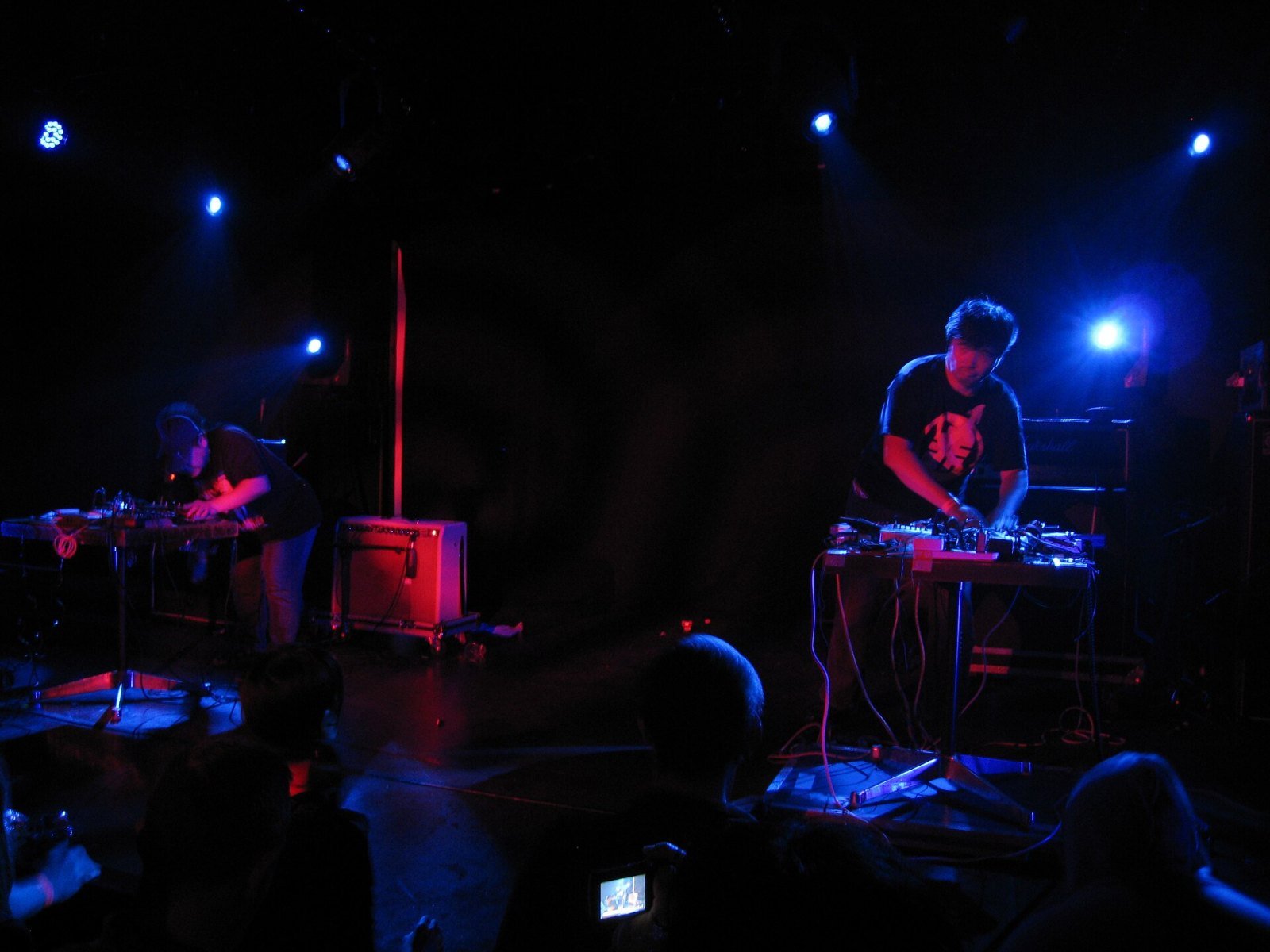
Incapacitants began in Osaka in 1981 as Toshiji Mikawa’s solo project and became a duo when Fumio Kosakai joined after Mikawa moved to Tokyo, around the early 1990s. The group is associated with Japanoise; its stated aim is “pure” noise, made with feedback, vocals and electronics rather than musical ideas. SARC identifies Alchemy Records as its chief outlet. [VERIFY: a complete, current label history.] The point is not simply that Incapacitants sound extreme. It is that they treat the refusal of conventional musical intention as a sustained practice.
A project apart from the group
Mikawa was already involved with Hijokaidan, the Osaka noise group, when he started Incapacitants. The two projects offered different contexts for his work: Hijokaidan was a group activity, while Incapacitants began as a solo outlet. In the early years Mikawa also collaborated with other musicians, including Yamantaka Eye, according to the supplied profiles. Those beginnings matter because Incapacitants was not initially a band with a fixed two-person lineup. It was a name under which Mikawa could pursue a specific approach to sound.
After Mikawa relocated to Tokyo, Kosakai joined. SARC describes the change as taking place around 1991, while the other profiles place it more generally after the move. Kosakai had also been involved with C.C.C.C. and later became a regular member of Hijokaidan alongside Mikawa. The stable duo brought together musicians with overlapping ties to Japan’s noise underground, but Incapacitants remained its own project rather than a side label for those other groups.
Noise as a deliberate limit
The phrase “pure noise” describes the pair’s stated aim: sound uninfluenced by musical ideas, or even by human intention. Kosakai’s term for the approach is “hard noise,” borrowed from the name of the jazz subgenre hard bop. The sources describe a working palette of feedback, electronics and voice. One account also mentions guitars, looped effects and homemade circuits, though those details should not be taken as a complete inventory of the duo’s equipment.
This idea is more useful than treating Incapacitants as a test of endurance alone. Their project sets a constraint: if melody, rhythm and conventional development are not the destination, what keeps a piece compelling? A review of the album Quietus describes three tracks that are difficult to distinguish from one another, with a saturated range of frequencies. That response captures both the strength and the risk of the method. Difference does not have to arrive as a new tune or a change of genre; it can emerge within a sustained field of sound. But a listener looking for familiar musical signposts may find little to hold on to.
The office outside the noise
Mikawa has worked in banking, and Kosakai in a government office, according to the supplied profiles. Their day jobs are not a decorative biographical detail: the sources note that titles on Incapacitants records and tracks often refer to professional or bureaucratic language. The contrast between salaried work and an uncompromising noise project gives the group a concrete identity without requiring an invented mythology about rebellion or outsider status.
The same practical circumstances have affected the duo’s ability to tour internationally. Their first international concert took place at Music Unlimited Festival in Wels, Austria, in November 1999, according to the profiles. That is a specific milestone, not evidence of a simple narrative in which the group moved from obscurity to an international career. The sources instead describe a project whose activity coexisted with ordinary employment and whose overseas appearances were limited by the members’ work.
Where to begin with the records
The discography is extensive, so a starting point is more useful than a long list of titles. SARC describes Repo (1989) as the group’s vinyl debut and an uncompromising noise record for its time. The same library presents Feedback of N.M.S. (1991) as three tracks combining junk metal, modular synthesis and improvisation. These descriptions offer two different entry points: one is framed as a landmark early release, the other gives a more specific account of its materials.
Default Standard (1999) is another documented option. SARC describes it as five tracks of feedback and electronic manipulation. Rather than treating these three records as a definitive ranking, they make a practical route through the available descriptions: an early vinyl release, a record foregrounding mixed sound sources, and a later album organized around feedback and electronic manipulation. The supplied sources also list As Loud As Possible (1995) among the group’s releases, but claims about its status as a high point or its reissue history are not consistently established across the material provided. [VERIFY: release and reissue details before making a fuller discographic claim.]
A place in Japanoise
Incapacitants is regularly grouped with Japanese noise acts that emerged in the 1980s, including Hijokaidan, Merzbow, C.C.C.C., Solmania, Hanatarash, the Gerogerigegege and Masonna. The useful distinction is not a claim that the group stands above those peers. It is that Incapacitants’ particular rationale—noise freed from musical intention—makes its output legible as more than a collection of loud recordings. Even the name “hard noise” suggests a practice with a defined commitment, rather than an effect used for shock.
That commitment also sets a limit on what a profile can claim. One review describes listening as a physical and mental experience, but that is the reviewer’s response, not a universal result. The firmer point is structural: sources repeatedly connect the project’s sound to feedback, electronics and voice, and connect its history to Mikawa’s solo beginnings and Kosakai’s later membership. Incapacitants’ interest lies in holding those elements against expectations of melody, message and dramatic change. The result is not an absence of choices. It is a choice to make noise itself the central subject.
Watch
Incapacitants the movie — INCAPACITANTS, via YouTube.
Sources
- Wikipedia, “Incapacitants”
- SARC, “Incapacitants”
- Industriv, “Incapacitants”
- Debaser, “Incapacitants - Quietus: Pure Noise Soundscape Review”
- _Black_Acrylic, “Incapacitants”
Sources
- en.wikipedia.org
- sarc.systems
- industriv.com
- en.debaser.it
- 0black0acrylic.blogspot.com
- music.ucsb.edu
- Image: Photo: furibond / Wikimedia Commons, CC BY-SA 2.0