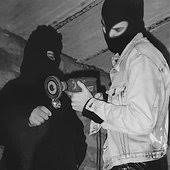
Hanatarash (ハナタラシ) was a Japanese noise unit formed in Osaka in 1983 by Yamantaka Eye, making sound by physically destroying objects and machinery rather than through instruments or amplified electronics. The name means roughly "snot-nosed" — a choice that refused seriousness from the start.
What set them apart from almost every other big Japanoise name was the sound source itself. Merzbow stacked layers of electronics. Hijokaidan staged chaos on top of amplification. Hanatarash went the other way and reduced the role of electricity: saws, drills, oil drums, and on one occasion an excavator. Academic documentation notes something strange about that practice — unamplified destruction was often drowned out by the audience's own screaming.
What the public actually recorded from Hanatarash was not sound. It was risk.
From stage crew to snot-nosed
Eye and Mitsuru Tabata met working as stage crew at an Einstürzende Neubauten concert. They agreed on one thing: punk had become too tidy and too predictable. The German group brought heavy metal onto the stage quite literally, and the lesson they took from it was not industrial aesthetics but permission — permission to use anything at all as an instrument.
Early releases were cassettes on their own label, Condome Cassex, through 1983 and 1984. The titles were deliberately childish and vulgar, the contents rough collages of household sounds, screaming, and low-fidelity field recordings. The first full-length, Hanatarashi, arrived on Alchemy Records in 1985 and marked the move from limited cassettes to vinyl.
Ikuo Taketani held a core position in the early years. He and Eye went on to found Boredoms in 1986, and Taketani later drummed for Zeni Geva. That lineage matters: Hanatarash was not a dead end but a doorway into two bands far better known outside Japan.
The audience signed waivers first
Before entering, Hanatarash audiences were asked to sign a release absolving the band of responsibility for injury. That was not a marketing gimmick. It was a risk calculation that turned out to be well founded.
The loudest sound in the room did not come from the band. It came from the people trying to get out of the way.
David Novak, Japanoise (Duke University Press, 2013)
This is where Hanatarash separated from its contemporaries. Merzbow made work that could be recorded and replayed. Hanatarash made events that could only be witnessed, and most of the documentation that survives is photographic rather than audio.
4 August 1985
The show at Toritsu Kasei Super Loft in Tokyo on 4 August 1985 ended Hanatarash's live career in Japan.
Eye drove a piece of heavy machinery through the front door of the building, into the performance space, and turned it among the scattering audience. It then struck a wall and left a large hole. Structural damage ran into the thousands of dollars, and afterwards practically no venue in Japan would take them.
One technical correction worth keeping. Most popular accounts call the vehicle a bulldozer, but Wikipedia and several other sources describe an excavator or backhoe loader. Photographs from that night show a digging arm, not a dozer blade. If you retell this story, use the right word.
Eye's own account of the night is flat, almost technical. He explained that the machine could rotate a full 360 degrees, so they spun around chasing the audience about the room until it finally hit the wall.
Why it still gets talked about
Hanatarash matters less as a discography than as a limit case. It marks the point where noise stopped being something played and became something survived — and where the distance between performer and audience collapsed into the same physical space.