DOD FX33 Buzz Box Review
An octave-fuzz pedal engineered to sound broken, discontinued after two years of poor sales, now going for $290 because the defect turned out to be the feature.
The first time I plugged in a Buzz Box, my neighbour knocked on the door. He thought my water pump had blown. I didn't explain.
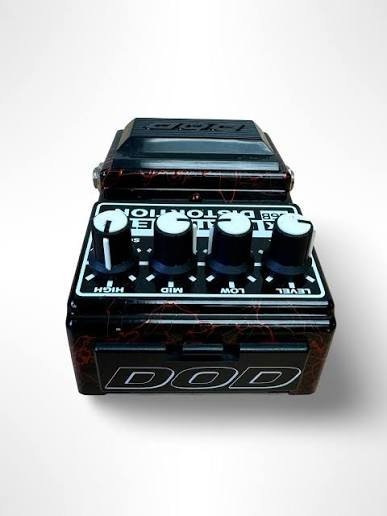
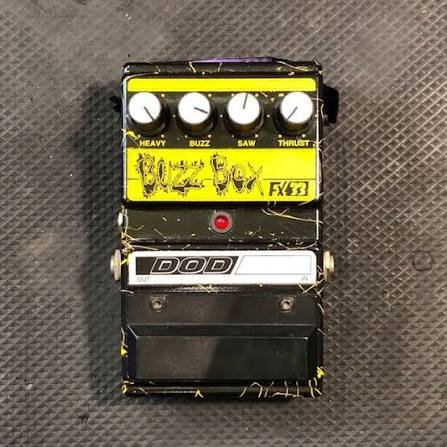
The DOD FX33 Buzz Box is an octave-fuzz pedal that splits your signal two octaves down, crushes it through a Grunge distortion circuit, and blends the two into something engineered to sound broken. It isn't a fuzz that thickens a note like a Big Muff. It's a pedal that destroys the pitch: the octave divider loses its grip constantly, and that tracking failure is the product.
"Octave fuzz" here means three things stacked in one enclosure: a high-gain distortion stage, a digital divider dropping two octaves, and a blend knob controlling how much of the damaged signal comes back. The worse the divider tracks, the more useful the pedal becomes, which is exactly why it bombed in guitar shops and got hoarded by noise musicians.
The defect is the feature.
Quick disambiguation: this is the FX33 Buzz Box. The FX32 is the Meat Box, a sub-harmonic generator that noise people also love but which does something completely different. Sellers mix them up constantly.
What is the DOD FX33 Buzz Box?
A distortion-plus-octave pedal built by DOD Electronics, released in early 1994 and gone from production by roughly 1996, designed to replicate the guitar sound of Buzz Osborne of the Melvins.
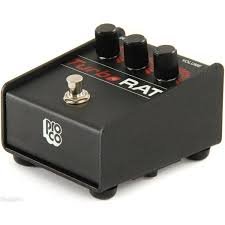
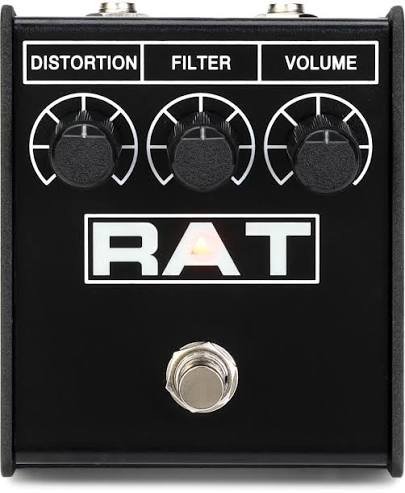
Here's how it happened. Jason Lamb, a designer at DOD, kept cornering Osborne at shows to ask how the guitar tone on Eggnog was made. The answer was unglamorous: a ProCo Rat pushing an early-70s MXR Blue Box. Lamb opened up that Blue Box, traced what was inside, and married it to DOD's own FX69 Grunge circuit inside a single enclosure with a yellow paint-splatter finish that looked nothing like the rest of the DOD catalogue.
Osborne had no involvement. Asked about it in Guitar World in February 1995, he distanced himself from the whole thing and wondered aloud whether his guitar really sounded that bad.
The pedal flopped. Shops started receiving returns because customers assumed the units were defective, and DOD ended up folding the explanation into their own marketing.
It's not broken, it's supposed to sound like that.
DOD marketing, 1995
That slogan was the most honest thing anyone said about this pedal. Thirty years later, it's why the price is absurd.
Why a commercial failure matters to noise musicians
Every quality that made the Buzz Box useless to guitarists made it valuable to people building walls of noise.
A guitarist wants predictability. Note in, note out, with a consistent flavour. The Buzz Box refuses. It converts your signal into ragged square waves, abandons pitch tracking the moment two notes sound together, and starts oscillating on its own if the impedance in front of it isn't to its liking. If you're constructing harsh noise, that disobedience isn't a bug report. It's raw material.
Community documentation from the scene is blunt about the social dimension too. Owning one was, for a stretch, a shortcut to noise credibility, and eBay prices climbed past $300 on scarcity and word of mouth alone.
I wouldn't tell anyone to buy gear for credibility. (I have, once, and the pedal sat in a drawer for a year, so take the advice from someone who ignored it.) But that reputation explains why the price has never softened.
How the circuit actually works
The Buzz Box runs two paths in parallel rather than in series, and that single design choice explains almost all of its strangeness.
Picture a blender with two separate jars. The first holds your signal after it's been mauled by the FX69 Grunge distortion: high gain, compressed, unmistakably mid-90s. The second holds your signal after two op-amp stages square it off and hand it to a CD4013 flip-flop, which divides the frequency by four. Two octaves down. The Heavy knob is the lever deciding how much from each jar ends up in the glass.
King Buzzo's actual rig worked differently. His Rat fed the Blue Box in sequence, so the octave circuit received a signal that had already been shaped and tamed. In the FX33, the two paths run independently and collide at the output. The result is messier than the thing it was copying.
Frequency dividers like the CD4013 only behave when fed one clean waveform. Give one a chord, or two sources at once, or noise, and it stutters, jumps an octave, drops out for a beat, then comes roaring back. That stutter is what people pay for.
What the four knobs do
The Buzz Box uses four control names that tell you nothing. There's a full breakdown in the KNOBS table at the end of this review — worth reading the sweet-spot column, because on this pedal the extremes are usually more useful than the middle, which inverts how nearly every other distortion box works.
Thrust is the knob everyone ignores. Turned down, the output doesn't just get quieter, it changes personality. Try there before you blame the pedal.
Against the Blue Box, Grunge and Meat Box
These four pedals get named in the same breath constantly, though only two of them are genuinely related. The COMPARISON table at the end sets out what each one can and cannot do, because on gear this specialised the limitations tell you more than the feature list.
The conclusion is uncomfortable if you already want the FX33. A Blue Box into a Grunge, wired in series, lands you in very similar territory for half the money. What you don't get is the parallel blend and the specific instability that comes with it.
Plenty of people say that difference isn't worth the premium. I mostly agree, with one exception I'll get to.
How it behaves in a noise rig
The Buzz Box belongs at the front of the chain as a source of chaos, not at the end as a colouring stage.
For my first three months I had it last, after delay and filters. Everything came out as the same brown sludge. Moving it to the front, ahead of the second distortion and ahead of the filters, was when it finally earned its space. Three wasted months I could have skipped by reading a forum first.
There's one technical detail that guitar-focused reviews never mention. The FX33's wild self-oscillation depends heavily on source impedance. Put any buffered-bypass pedal in front of it and the screaming stops, while the octave tracking noticeably improves. That buffer is effectively a hidden mode switch: leave it in for a better-behaved octave, take it out when you want the pedal to howl unprompted.
Your source matters just as much. From a guitar with the neck pickup's tone rolled off, the divider tracks about as cleanly as it ever will. From mixer feedback or a contact mic, tracking collapses completely and the pedal becomes an unpredictable stutter generator. From a synth, it turns a flat patch into something serrated, and a lot of long-time owners consider this its best use by a wide margin.
What it won't give you is dynamics. This pedal has two states, on and off, and it responds to pick attack almost not at all.
The limitations
The real weakness isn't the sound. It's the price-to-contribution ratio for anyone who already owns a fuzz and an octave pedal.
The practical complaints stack up fast. DOD footswitches from this era are fragile and are usually the first thing to fail on a used unit. There's no true bypass, so your signal runs through the circuit even when the pedal is off. The noise floor is high, hum is obvious in the gaps, and some clones are reported to hiss more than the original. The stock pots use a W taper that's now difficult to source, which makes servicing a real project rather than a quick swap.
There's a sharper criticism from inside the scene: the pedal doesn't live up to its own mythology. Several long-term owners describe it as a chaotic distortion with an octave feature attached, nothing more, and read the current price as pure scarcity premium.
I think that's fair. The Buzz Box does one very specific thing extremely well and does nothing else at all. If you want versatility, this is the wrong box.
What it costs, and whether to buy one
As of April 2026, market listings track the FX33 around $290, with a reasonable range of $250 to $350 depending on condition and whether the original box and adapter are included.
That's roughly five new fuzz pedals, or a decent small mixer. Worth holding in your head before you click buy.
The SHOULD YOU BUY table at the end isn't a spec sheet, it's a decision tool. Find the row that sounds like you and read across.
Borrow, rent, or build one first. If it's still switched on two months later every time you make sound, then go find an original.
The verdict
Clones and alternatives
Everything below attacks the same problem — getting a badly-tracking sub-octave and a high-gain distortion into one signal path — through three different routes.
Finished clones. The Mantic Hivemind is a hand-built replica made in tiny batches, roughly ten units a year over a few years, which makes finding one nearly as hard as finding the original. The Audible Disease 33 surfaces on the used market more often, though some owners report a higher noise floor. Dirt Monger Instruments has also offered a Buzz Box Deluxe variant.
Build it yourself. Griffin Effects sells a reproduction PCB called the FX33 Buzz King, with a parts list and a 1590BB enclosure drill template. Community-traced schematics have circulated on DIY forums since the mid-2000s. This is the cheapest route by a wide margin and the one I'd point most people toward.
Different circuit, related result. The MXR Blue Box is still in production and delivers comparable glitch octave for a third of the price. The EarthQuaker Devices Bit Commander offers square-wave octaves with far more control. A Boss OC-2 driving a DOD Grunge gets named regularly as a close-enough substitute.
One warning about clones. Because instability is the whole point, build-to-build variation is audible in a way it wouldn't be on a Tube Screamer. Component tolerances that nobody would notice elsewhere change how this circuit misbehaves.
Who actually uses one
Owners split cleanly into two camps that rarely talk to each other: rock musicians who bought it because of the Melvins, and experimental musicians who bought it because it's broken.
From the first camp, Greg Anderson of Goatsnake and Sunn O))) uses one, and the octave's failure to track is audible on Goatsnake recordings if you know what to listen for. Wes Borland is documented using one in Limp Bizkit's early years.
From the second, Oren Ambarchi has run one as part of his drone rig. Romain Perrot, who records as Vomir and effectively defined the harsh noise wall aesthetic, has described a setup built from mixer feedback, filters, a ring modulator, a Buzz Box, and a Meat Box.
That last name is the one that matters for this site's readers. If you're chasing HNW territory, you're looking at a component used by someone who shaped the genre.
FAQ
What's the difference between the FX32 and the FX33?
The FX32 is the Meat Box, a sub-harmonic generator with 30 Hz and 60 Hz boosts that produces extremely low frequencies. The FX33 is the Buzz Box, a distortion with a two-octave-down divider. Both came out in 1994 as part of DOD's Jason Lamb series and both are popular in noise, but they do entirely different jobs.
Why is it expensive if it's supposedly bad?
Production stopped after about two years because sales collapsed, leaving very few units in circulation while demand from noise and synth musicians kept climbing.
Is it good for bass?
It works, but the distortion stage strips out a lot of low end, so bass loses its body. For low-frequency work the DOD FX32 Meat Box is the far better tool.
Does it have true bypass?
No. The signal passes through the circuit even when the pedal is off, and the 90s-era DOD footswitch is the most common failure point on used units. Many owners modify theirs to a 3PDT switch.
Why does the octave keep dropping out or jumping?
Because the CD4013 divider needs a single clean waveform to lock onto. Feed it a chord, two simultaneous sources, or noise, and it loses its reference and starts skipping. Tracking is most stable from one note with the tone rolled off on a neck pickup.
Why does mine oscillate with nothing plugged in?
Self-oscillation is normal FX33 behaviour and is strongly affected by source impedance. Placing any buffered-bypass pedal in front usually stops the oscillation and improves octave tracking at the same time.
Which clone is closest to the original?
The Mantic Hivemind has the strongest reputation, but production was tiny and units rarely appear. The Audible Disease 33 is easier to find, though some owners report more hiss. For anyone who solders, the Griffin Effects FX33 Buzz King PCB is the cheapest path.
Can an MXR Blue Box replace it?
Mostly. The Blue Box delivers the same unstable two-octave drop for roughly a third of the price and is still made new. What's missing is the built-in Grunge distortion and the parallel blend that makes the FX33 sound more damaged.
Where should it sit in the signal chain?
At the front, as a chaos source, before your second distortion and before any filters or delay. Putting it last tends to flatten everything upstream into the same texture.
Is it still in production?
No. Production ended around 1996 and DOD has never reissued the FX33. The only routes are the used market, a clone, or a DIY build.
My neighbour never asked about that sound again. The Buzz Box is still in the same box it arrived in, still first in the chain, still switched on whenever I need something that refuses to follow instructions. Two years in, I stopped trying to make it sound good.
It was never built for that.
Sources
America's Pedal — production history and serial data · JHS Pedals — the DOD Jason Lamb series · Reverb — product page and price history · freestompboxes.org — schematic tracing · Dirtbox Layouts — DIY layout and buffer notes · Griffin Effects — reproduction PCB · themelvins.net BBS — owner discussion since 2004