Comment / Sound Art Art of Noise, Without the Noise
Cooper Hewitt borrowed its title from the 1913 manifesto that invented noise as an art form, then filled three hundred objects with hi-fi stereos and psychedelic posters. Not a failure — but worth naming what the word means in a museum.
The Smithsonian's design museum has just closed an exhibition called Art of Noise. Three hundred objects, the whole third floor, a handmade listening room downstairs, and a set of singing sculptures by teenage engineering. It is a real show and by all accounts a good one. It contains no noise music of any kind.
Where the title comes from
In 1913 the Italian futurist painter Luigi Russolo published L'arte dei rumori — The Art of Noises. It argued that the ear had been trained on too narrow a band of sound, that industry had filled the world with a richer and uglier vocabulary, and that music should follow. He built machines called intonarumori to prove it: boxes with cranks and levers that roared, hissed and scraped. Audiences at the early performances reportedly fought.
That document is the reason this archive exists. Nearly every argument made since about noise as a form — by Merzbow, by The Haters, by the wall artists in our field guide — is downstream of a painter in 1913 insisting that ugly sound was worth organising.
What the show actually held
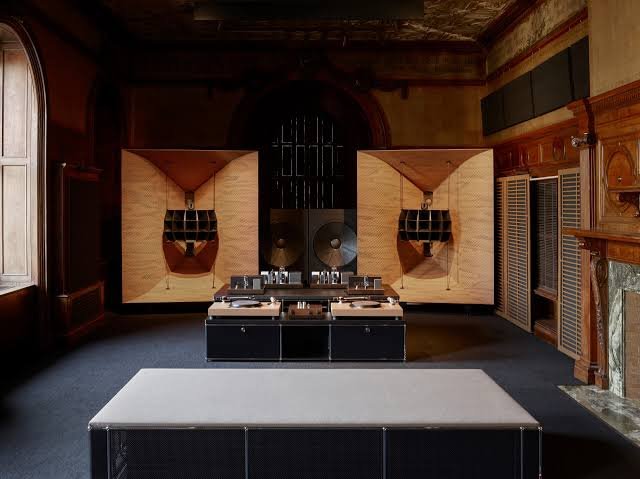
Concert posters. Album covers. Phonographs, transistor radios, boomboxes, the Sony Walkman, the iPod. Hi-fi systems by Dieter Rams and Achille Castiglioni. Blue Note sleeves by Reid Miles, salsa covers by Izzy Sanabria, Talking Heads artwork by M&Co. Psychedelic rock posters by the dozen. A haptic suit that turns sound into touch.
By the museum's own description, the subject is how design has transformed people's relationship to music over the past 100 years. Which it plainly is, and does well. The word in the title is doing no work at all — swap in Art of Listening and nothing in the object list changes.
Russolo wanted machines that made sound worse. The exhibition that borrowed his phrase is a century of machines engineered to make sound better, smaller and more convenient. Those are not adjacent projects. They are opposite ones.
This is not a complaint
The show never promised noise music and should not be judged for not delivering it. Curator Joseph Becker built it around design and consumption, and the press material says so in the first sentence. Nobody was misled who read past the title.
What is worth noticing is narrower: noise is now a word museums can put on a banner because it reads as energy, edge, modernity. Stripped of the thing Russolo meant, it has become a texture — the same way industrial ended up describing furniture.
The show that has not happened
There is an obvious exhibition nobody has staged. The intonarumori and their reconstructions. Contact microphones and no-input mixers. A junk table. The Haters' Untitled Title Belt — a wrestling championship belt that is also a microphone, a distortion pedal and a noise generator. A wall of hand-dubbed cassettes from labels that never had a distributor. A room where a Vomir set plays at its intended volume, unchanged, for its full length.
It would be difficult to insure, unpleasant to sit in, and thinly attended. It would also be the first museum show to use that title accurately.
Sources
Contents, curators and framing from the Smithsonian press release of 10 September 2025. That release gives the run as 12 December to 19 July 2026; several listings give 13 February to 16 August 2026. Both are reported above because we could not settle which is right, and exhibitions are extended often enough that neither is implausible.